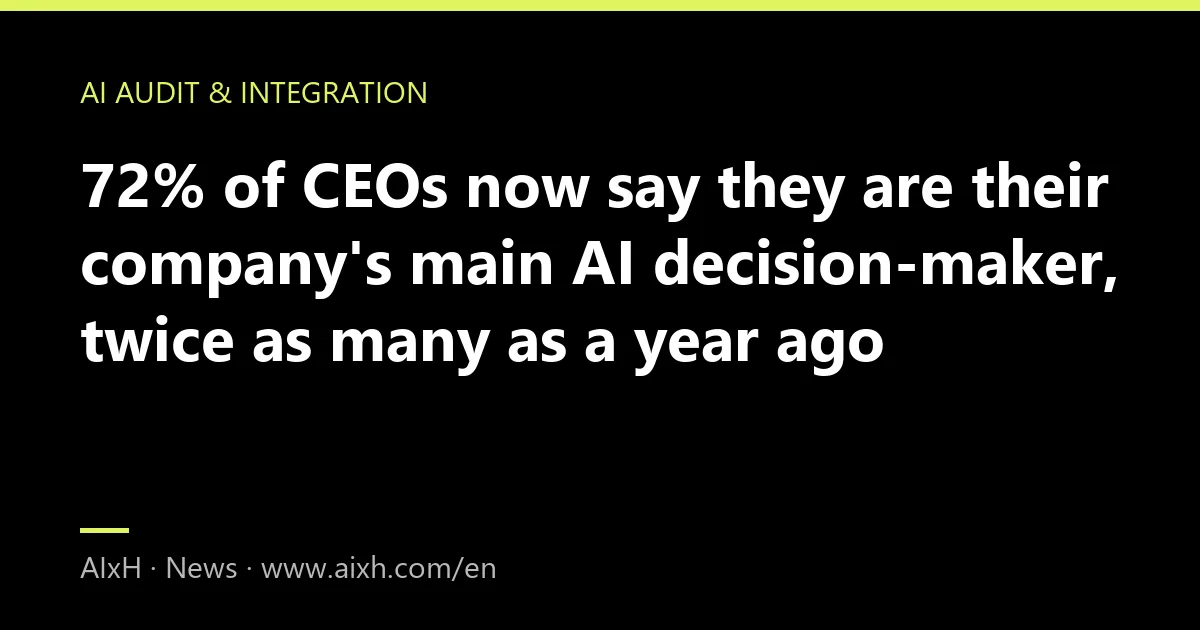
According to the BCG AI Radar 2026, 72% of CEOs now describe themselves as the main decision-maker on AI, twice as many as a year ago. The subject is leaving the technical perimeter: AI budgets double in 2026, and half of CEOs consider their job at stake if the strategy fails.
The facts
- According to the BCG AI Radar 2026 (640 CEOs, 16 countries), 72% of CEOs describe themselves as the main decision-maker on AI, twice as many as a year earlier, and AI investment doubles in 2026 to reach 1.7% of revenue.
- According to the IBM Institute for Business Value (2,000 CEOs, May 2026), 76% of organisations now have a Chief AI Officer, against 26% a year earlier, most often reporting directly to the CEO.
- In France, the Bpifrance Le Lab study (1,209 SME and mid-cap leaders) shows that 73% of AI projects are driven directly by the CEO, with a risk it identifies itself: without the teams' involvement, adoption remains fragile.
Is this shift towards the top enough to guarantee success?
This shift is explained first by trust: according to Gartner, only 44% of CIOs are judged competent in AI by their own leadership, which explains the reluctance to delegate the subject outright. But the MIT NANDA report, which finds that 95% of generative AI pilots in companies produce no measurable impact on results, attributes this failure to organisational design rather than to the tools or to a lack of steering from the top.
Its conclusion precisely qualifies the idea of exclusively centralised steering: the projects that succeed decentralise execution to trained teams, while keeping accountability at the top. BCG confirms this pattern in its own way: the most advanced CEOs devote 60% of their AI budget to training and train more than 65% of their employees, twice as many as other CEO profiles.
AIxH's view
That is the point of our AI training for CEOs and managers: training all managers, beyond the IT department alone, so that decisions stay at the top without cutting off execution by the teams who live with the subject every day. Our sessions are tailored to each client's identity, within the framework of our authorisation from the Ministry of the Economy. If you want to assess the AI maturity of your leadership team, an initial conversation is enough to establish a diagnosis.